WHY EVERYONE IS WRONG ABOUT THE COMMONWEALTH SHORT STORY PRIZE AI SCANDAL
The 2026 Commonwealth Short Story Prize shortlist just came out and the best writer in the Caribbean is ChatGPT according to Pangram

If your country was once colonized by the British and you write stories, you’ve probably heard about the Commonwealth Short Story Prize. It’s a big award. Probably bigger than the BET Awards if it was in literature. Definitely bigger than the Headies and AMVCA. I think its equivalent would be the British Academy Film Awards (BAFTA), if it was just for short stories.
I was a teenager the first time I discovered the Commonwealth Short Story Prize, and ever since, I’ve been following it every single year like a religious event. The selected stories are always interesting and mostly available to read on Granta. They always make me jealous as a writer that I did not come up with them, even when I couldn’t have realistically done so because literature at the core of it, is motivated by personal experience. That’s just how unique the selected stories are.
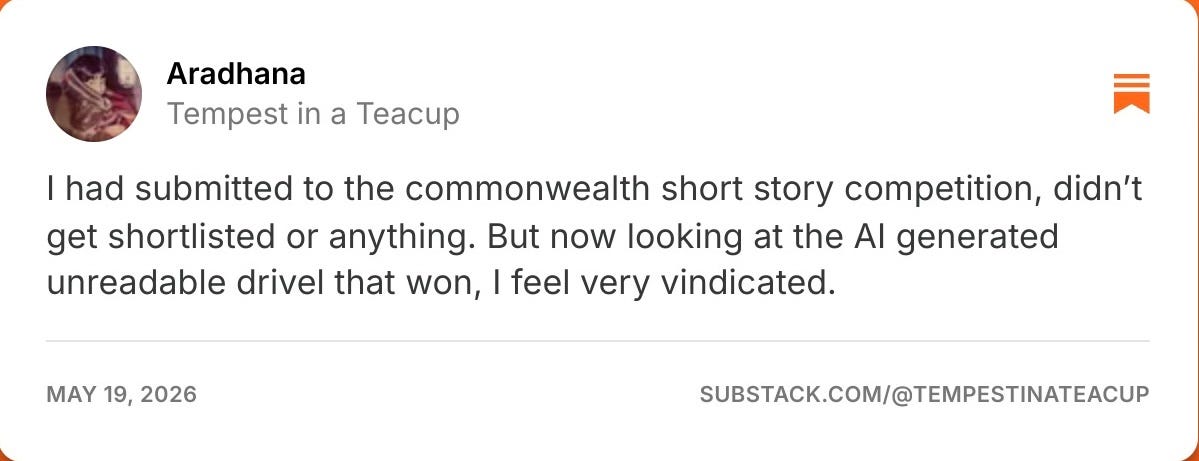
However, this year, one of the selected stories seems to have been written partially or entirely by artificial intelligence, according to Pangram, and everyone is tripping over themselves because of it. I’ve read all sorts of reactions from shock to dismay to disappointment and I found all the reactions very interesting. So, I took the time to read the entire story and here’s my opinion as a Commonwealth Short Story Prize fan girl of 10 years (I’ll be calling it CSSP from here on). It’s not that shocking and the story titled the Serpent in the Grove by Jamir Nazir, isn’t actually that bad no matter what Aradhana here has to say about it.
Now, before you crucify me, let me break it down for you.
CSSP Awards Ideas Not Stories
Anyone can tell a story, but not everyone can write something that’s truly provocative and can make you think.
For as long as I’ve known the CSSP, all selected stories (on the longlist and shortlist) have always been provocative. More than 7000 people submit their short stories to the award each year, and what sets winning stories apart is the intellectual bait, the high-concept. Judges want to know that there is a background or discussion surrounding your story.
It also doesn’t help that entries for the Commonwealth Short Story Prize are regionalized. So, apart from something that sounds intellectual, they also want something cultural. If you’re an African, they want a story that says, “I live on this soil and it speaks to me. I spend my days counting stories in its pebbles, and this is just one of them.” In short, you need to put your identity in your entries.
This is what human writers sometimes struggle with. At least, I know I struggle with it because I’m not exactly a fan of anyone telling me how to write my stories but AI is great at it. Tell it to create a tantalizing recipe from regional folklore, spice it up with some tragic contemporary issue, and you get a premise that’s as grand and ambitious on paper as The Serpent in the Grove.
The judges saw this ambition and ran with it while ignoring the fact that the execution itself was clunkier than a broken microwave.
For instance, after reading the story, I can’t seem to figure out if bush refers to actual foliage, a symbol or a person. Take these two excerpts from the story for instance:
The ring of stone lay there where cocoa gave to bush, its mouth boarded with ply and chance. People said the British had dug those wells when they tried to plant where forest wanted to be…
To me, “bush” here mean foliage. I assume this means there’s some foliage close to the cocoa plants, close to where the ring of stone lay. However, in the same paragraph, our genius writer wrote:
Vishnu usually avoided it. Bush kept it, snakes liked it, air from it felt like a hand from a grave. He went there now. With the cutlass tip he prised a plank. Cold air climbed his arm, jasmine and rot braided tight. It was not empty down there. It was waiting.
Here, the bush is now doing something. It’s probably a person or a symbol, but it’s written so badly that you’d imagine a person named Bush is keeping something if you don’t read it twice. This is not the only time the story becomes confusing because of weird descriptions either.
The well is central to the story, and from the title, you can tell it’s supposed to be in the grove. However, through the course of the story, I can’t tell if the well is actually close to Vishnu and Sita’s home or not. However, Jamir Nazir is not an idiot; you get sprinkles of sentences that would really excite a typical CSSP judge all over the story. One of them is about British rule. The circle of stones that held the well was conveniently built by the British, even though that information doesn’t matter to the story at all.
Another example is this sentence, which does nothing but emphasize that women can be strong and fight oppression even when they themselves don’t have much:
Marsha was shelling pigeon peas and thinking about a letter she’d promised to write for a mother whose son had been held for cussing a policeman.
CSSP Loves Relevance and Emerging Issues
AI doesn’t have as much depth as the average writer, but it has data. It knows what is currently trending globally and in the literary world. As writers, I hate that we are often unwittingly drawn into political intrigue, but that’s just how it goes, sometimes.
Take George Orwell’s 1984 or Animal Farm for instance. Both stories are political intrigue and satirical in nature which is exactly what makes them popular till today. Catch 22 by Joseph Heller is also another politically intriguing story that has managed to stand the test of time. All these stories dealt with massive tragedies and political issues of their time. The Commonwealth Short Story Prize awards something similar.
Jamir Nazir's story specifically deals with femicide, which is admittedly a very painful, urgent, and heavily discussed global issue. When an actual writer tells a story about femicide, it often comes from a place of empathy and lived experience. The story obtains emotional weight that can actually make a difference when applied correctly.
AI however, does not care about all these things but it’s great at recognizing patterns and figuring out what’s likely to win. It only made a calculation that probably looks this:
Take [Caribbean Regional Folklore], Multiply by [High Stakes Social Justice Issue: Femicide], Add [Vivid Flora and Fauna Descriptions] = The Ultimate CSSP Application Prompt.
And you can’t really deny that it worked. After all, it’s the regional winner for the Caribbean.
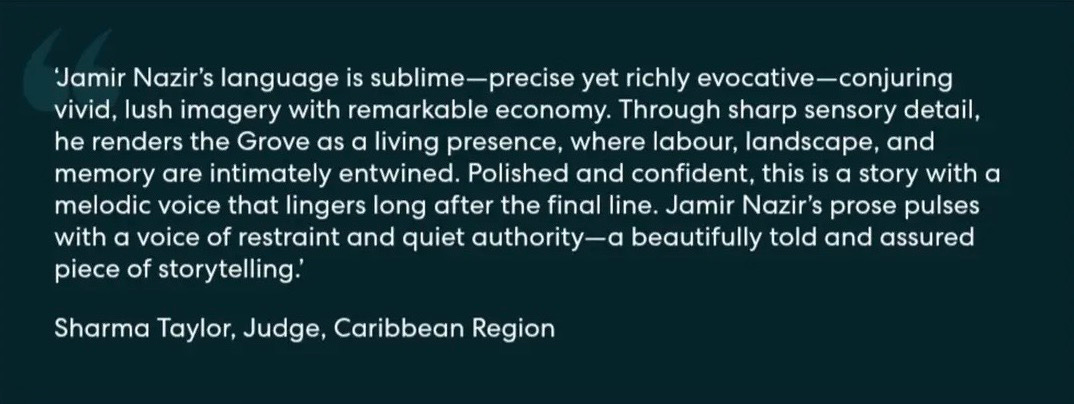
The story sets itself apart by telling a topic the judges feel morally obligated to validate. The topic is a devastating reality, and anyone in their right mind would want to elevate the voice telling that story. So, when the judge representing the Caribbean region, Sharma Taylor said: “This is a story with a melodic voice that lingers long after the final line.” I’m sure she meant it. After all, what resonates more than femicide?
CSSP Isn’t Just About Grammar
For obvious reasons, CSSP cannot afford to care about grammar. Let’s crunch the numbers, shall we?
The Commonwealth consists of 56 countries spanning across Africa, Asia, the Pacific, the Caribbean, and Canada/Europe. Many of these countries don’t use English as their first language, which is why entries are allowed in multiple languages that are then translated into English.
When stories are translated from a different language, the sentences can become clunky and depending on the translator’s skill level, there may be some distortion in linguistic transfer.
Furthermore, in the world of the modern Caribbean literature, bad grammar isn’t a mistake, it’s an artistic choice.
If a truly human writer turns in a work that is barely coherent, reviewers and judges tend to call it it avant garde. Think of it as an experimentation or subversion of the widely accepted Western Linguistics syntax. It’s trendy and rebellious!
This is probably why none of the judges thought Jamir Nazir’s story was written by AI. They weren’t thinking: “This sounds like an LLM that ran out of tokens towards the end.” Instead, they were thinking: “Ahhh! What a truly refreshing and intriguing stylistic choice. Look at how the writer intentionally breaks down form to reflect the fragmented reality of post-misogynistic trauma.”
In these situations, what looks like an error to everyone else can be passed off as a style. This creates a situation where AI-generated inconsistency can look like stylistic experimentation, and translation noise on paper.
The Story Is Not Good, But It’s Also Not Bad
I’m not going to go as far as to say the story is good because it’s not. It uses a lot of generic tropes. The similes and metaphors are forced. I’ve read a lot of bad stories in my life but never have I ever seen someone misuse all literary devices as much as this in all those years. Take this sentence for example:
"Hard living lays itself on a man like wet sacking; it never asks permission."
Or this:
“Maybe it was a name; maybe rain took a shape and decided to keep it. She had the kind of walking that made benches become men.”
Everything is a mess, but does that make this a bad story? No, because this story actually has a structure.
The narration began after the story has already ended. We’re introduced to the Grove, then to Vishnu, then to his wife Sita. Zoongie enters the story as the catalyst that changes Vishnu’s boring life enough to propel him to attempt murder. Next, we’re introduced to Puttie, who somehow quietly knows things are about to change, then Marsha, who’s the strength, the one who eventually rescues Sita from the well.
The story has a structure. There’s tension and conflict where it needs to be, and if you strip away the terrible AI-generated narration, the story probably has more structure than most of what all of us have sitting in Google Docs.
Make no mistake though, simply because a story isn’t completely bad doesn’t mean it deserves an award. But until we have a frank discussion about what storytelling truly means, how judges should analyze stories, and what form of AI use is acceptable in literature, I fear this may just be the beginning.
Hi May,
I’m not here to defend Jamir nor can I say if the story was or wasn’t written by AI. However, I’d like to clarify a lot of misconceptions in your article.
First, “Bush” in Caribbean usage means wilderness, unkept land, thicket. The author anthropomorphises it here in the same way an American author might anthropomorphise “The Forest.” It’s not referring to Vishnu’s crops, but the weeds and shrubs that surround his farmland and are constantly encroaching on it. As for the location of the well, it’s clearly stated that the well is located where the cocoa meets the bush, so on the edge of the property. Not near their home, but definitely not far as they only have an acre or so.
The well is a metaphor for their marriage- once decrepit, later redeemed. The fact that the well was dug by the British has nothing to do with colonialism. The author is communicating that the well was abandoned, it served no purpose, perhaps some of the neighbors aren’t even aware of its existence. It communicates that Vishnu’s planned murder of Sita was not a crime of passion, but carefully pre-meditated by Vishnu to resemble a legitimate accident. And finally, it emphasizes that Marsha finding Sita was a premonition, divine intervention, as there’s no plausible way Marsha could have known to go look in an old abandoned well at the exact moment Sita fell in.
Finally, crucially, the story is not feminist in any way. It’s explicitly anti-feminist. The key message of the story is one of forgiveness, not justice. Sita, fully aware of Vishnu’s disdain for her, his desire for Zoongie, and his attempt to murder her, instead chooses to forgive him. And that unspoken forgiveness, the willful ignorance, the pretense that the near-murder actually was just an accident- that becomes the catalyst for a deeper relationship between Vishnu and Sita that blossoms into something vaguely resembling love. Sita knows Vishnu tried to murder her (for that matter, Marsha does too), but they both cover up for him instead of seeking justice. How does that resemble modern feminism?
And eventually Sita manages to forgive Zoongie as well, describing the act as freeing, a weight off her shoulders.
The Serpent in the Grove is a twist on the Biblical story of David and Bathsheba, one where a husband is driven to murder by lust for another woman. A modern version, set in 20th century Trinidad, it’s a version with a “happy” ending, where the husband’s murderous intent is thwarted by divine intervention, and both his lust and later his guilt are quelled by forgiveness from the woman he tried murder. In some ways, it more strongly embodies Judeo-Christian values than the story that actually appears in the Bible.
Most of all, it’s a Caribbean folktale, with Caribbean metaphors, written in Caribbean language with a Caribbean voice (it’s easy to envision the narrator as Marsha, or perhaps an elderly version of Sita herself), and it deserves to be read and understood through a Caribbean lens.